Download MIPS Assembly Language Programming
After reading this book, you will truly know how precisely the relevance of reviewing publications as usual. Assume again as what this MIPS Assembly Language Programming offers you brand-new lesson, the various other publications with lots of themes and also genres and also million titles will additionally give you very same, or greater than it. This is why, we always supply just what you require as well as what you have to do. Several collections of the books from not just this nation, from abroad a nations in the world are provided below. By offering very easy method in order to help you discovering the books, hopefully, reviewing habit will spread out quickly to other individuals, also.
MIPS Assembly Language Programming

Download MIPS Assembly Language Programming
In suiting the new updated book launched, we involve you. We are the internet web site that constantly offers a very excellent way, excellent term, as well as wonderful checklists of the collections books from numerous countries. Schedule as a fashion to spread out the information and also details regarding the life, social, sciences, religious beliefs, lots of others holds a very important rule. Book may not as the fashion when they are out of day, they will certainly function as absolutely nothing.
Why should be this e-book MIPS Assembly Language Programming to check out? You will never obtain the knowledge as well as experience without getting by on your own there or trying by on your own to do it. Hence, reading this publication MIPS Assembly Language Programming is needed. You could be great and appropriate enough to obtain just how important is reviewing this MIPS Assembly Language Programming Even you constantly read by commitment, you could sustain on your own to have reading e-book routine. It will be so valuable as well as fun after that.
Yeah, spending time to review the e-book MIPS Assembly Language Programming by on the internet can additionally give you positive session. It will certainly relieve to communicate in whatever problem. In this manner could be a lot more fascinating to do and simpler to check out. Now, to obtain this MIPS Assembly Language Programming, you can download in the link that we give. It will aid you to obtain easy method to download guide MIPS Assembly Language Programming.
After getting this book, it will certainly be better for you to read it immediately. This publication will interact the description and factors of why this publication is most desired. It will certainly be the ways you acquire the brand-new ability and also skills to be far better. Naturally it will certainly assist you to face the issues of target date tasks. MIPS Assembly Language Programming is extremely considerable to do and also obtain, so what sort of publication material that you need now? Find them in the lists of this site.
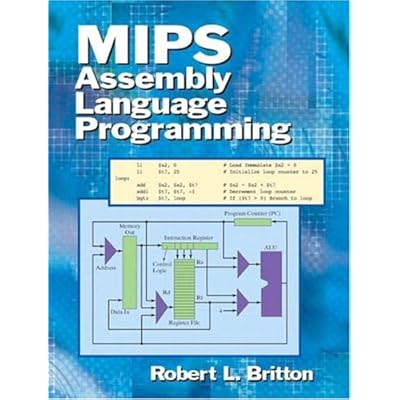
From the Back Cover First impressions are important. To introduce your Assembly Language programming students to the fundamental concepts of contemporary computer architecture, start with a Reduced Instruction Set Computer (RISC). When students first encounter computer architecture, they need to begin with the basics of modern computer organization. The MIPS architecture embodies the fundamental design principles of all contemporary RISC architectures: All instructions are directly executed in hardware The rate at which instructions are issued is maximized Instructions are easy to decode Only load and store instructions reference memory Plenty of general purpose registers are provided (32 for MIPS) MIPS Assembly Language Programming offers students an understanding of how the functional components of modern computers are put together and how a computer works at the machine-language level. The book begins with a datapath diagram that shows a simple implementation of the MIPS architecture, consisting of a register file, an ALU, a memory. a program counter, and an instruction register. As students progress through the text, they will elaborate on this established datapath diagram model, allowing them to visualize how the instructions are fetched and executed as they write their programs. The Spim simulator for the MIPS architecture runs on PC's and Unix® systems. All the programming exercises are done using this simulator, which can be downloaded for free from the Internet. Using the MIPS simulator allows students to observe the contents of the registers and memory change as their programs execute. The students are not isolated by a particular operating system from experiencing and writing code dealing with: Memory-mapped I/0 Interrupts and exception processing Delayed loads and delayed branches for a pipelined implementation It is assumed that students using this text already have some experience in developing algorithms, and running programs in a high-level language. The skills they will learn with MIPS Assembly Language Programming offer a sound basis for advanced work in computer architectures and complex assembly languages. Read more Excerpt. © Reprinted by permission. All rights reserved. This text is targeted for use in an introductory lower-division assembly language programming or computer organization course. After students are introduced to the MIPS architecture using this textbook, they will be well prepared to go on to more advanced courses in computer organization where any modern reduced instruction set computer (RISC) is analyzed. This text provides a technique that will make MIPS assembly language programming a relatively easy task as compared to writing complex Intel™ x86 assembly language code. The skills learned, as a MIPS assembly language programmer, will facilitate learning other more complex assembly languages if the need ever arises. Students using this text will acquire an understanding of how the functional components of modern computers are put together, and how a computer works at the machine language level. It is assumed that students using this text already have some experience in developing algorithms, and running programs in a high-level language. Chapter 1 provides an introduction to the basic MIPS architecture, which is a modern RISC. Chapter 2 shows how to develop code targeted to run on a MIPS processor using an intermediate pseudocode notation similar to the high-level language C. Once an algorithm is specified in this pseudocode notation it is a relatively simple task to translate it to MIPS assembly language. Chapter 3 is an introduction to the binary number system. This chapter provides simple procedures for converting values from one number system to another. The rules for performing binary arithmetic are explained. Students will learn how to detect when overflow occurs. Chapter 4 explains the features of the PCSpim simulator for the MIPS architecture, which is available for free. Within the remaining chapters, a wealth of programming exercises are provided that every student needs to become an accomplished assembly language programmer. Instructors are provided with a set of PowerPoint slides. After students have had an opportunity to develop their pseudocode and the corresponding MIPS assembly language code, they can be shown example solutions to each of the exercises via the PowerPoint slides. In Chapter 5, students are presented with the classical input/output (I/O) algorithms that involve converting numbers between their integer binary representation and their ASCII decimal and hexadecimal representation. The utility of logical operators and shift operators are stressed. In Chapter 6, a specific argument-passing protocol is defined. Most significant programming projects are a teamwork effort. Emphasis is placed on the important fact that everyone involved in a teamwork project must adopt the same convention for parameter passing when calling functions. In the case of nested function calls, a specific convention is defined for saving and restoring values in the temporary registers. In Chapter 7, the necessity for reentrant code is explained, as well as the rules one must follow to write such functions. In Chapter 8, students are introduced to memory-mapped I/O. The MIPS simulator provides a memory-mapped I/O feature so that students can gain experience in writing drivers that interface with physical devices. With this PCSpim feature, students can gain experience in writing code to communicate character by character with physical I/O devices. The code that communicates with a physical device at this level is often referred to as a driver. This is a significant advantage of using a simulator to learn assembly language programming. Students learning to write native assembly language typically never have an opportunity to write code that interfaces directly with the I/O devices. These students have to be satisfied with making calls to Basic Input Output System (BIOS) procedures that handle the details of communicating with the I/O devices. Typically these students never experience the real-world challenges that arise as a result of the communication and device time delays. Chapter 9 introduces exceptions and exception processing. PCSpim responds to interrupts generated by the memorymapped keyboard and display terminal. Given this feature, students have an opportunity to experience writing code to respond to interrupts. Once again this points out the advantage of using a simulator when learning to write assembly language code. Students learning to write assembly language code for their desktop computer typically never have an opportunity to write and run interrupt handlers that enable and disable the interrupt system. Typically these students never experience the real-world challenges that arise in writing the code that resides at the very heart of the operating system. In Chapter 10 a pipelined implementation of the MIPS architecture is presented, and the special programming considerations dealing with delayed loads and delayed branches are discussed. PCSpim provides an option to run the simulator as if the code were executing on a pipelined implementation of the MIPS architecture. Using this option, students gain experience in writing assembly language code that will run on a pipelined implementation. Chapter 11 provides a description of the floating-point features of the MIPS architecture, as well an introduction to the IEEE 754 floating-point standard. I would like to acknowledge Bary Pollack, James Gips, Doug Milhous, and Dwite Brown who adopted the earlier draft versions of this textbook. I wish to express my special appreciation to Bary Pollack and Tom Fountain for their thorough review of my initial submission to Prentice Hall, and their many constructive recommendations for improvements. The feedback from Seyed H. Hosseini, and Wagdy H. Mahmoud was also quite helpful. I also wish to thank Petra Recter, senior computer science editor, and John Keegan, production editor, both at Prentice Hall, who so effectively managed this project. I am especially grateful to my wife, Jan, for her support and encouragement. She is my true helpmate and soul mate. Robert Britton April 2003 Read morePaperback=168 pages. Publisher=Pearson (June 7, 2003). Language=English. ISBN-10=0131420445. ISBN-13=978-0131420441. Product Dimensions=6.8 x 0.5 x 9 inches. Shipping Weight=9.9 ounces (View shipping rates and policies). Average Customer Review=4.0 out of 5 stars 19 customer reviews. Amazon Best Sellers RankAssembly Language ProgrammingComputer DesignDesign & Architecture=#240,207 in Books (See Top 100 in Books) .zg_hrsr { margin: 0; padding: 0; list-style-type: none; } .zg_hrsr_item { margin: 0 0 0 10px; } .zg_hrsr_rank { display: inline-block; width: 80px; text-align: right; } #13 in Books > Computers & Technology > Programming > Languages & Tools > #27 in Books > Computers & Technology > Hardware & DIY > Microprocessors & System Design > #127 in Books > Computers & Technology > Hardware & DIY >.
MIPS Assembly Language Programming PDF
MIPS Assembly Language Programming EPub
MIPS Assembly Language Programming Doc
MIPS Assembly Language Programming iBooks
MIPS Assembly Language Programming rtf
MIPS Assembly Language Programming Mobipocket
MIPS Assembly Language Programming Kindle